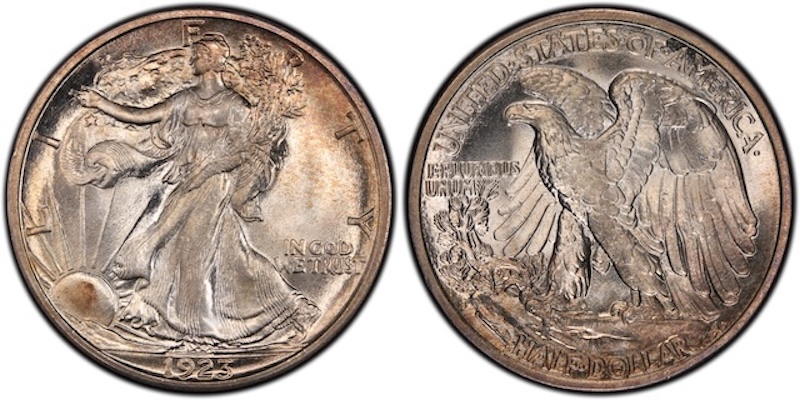
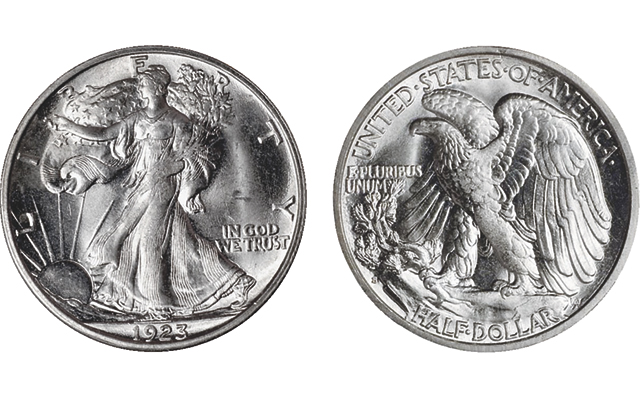
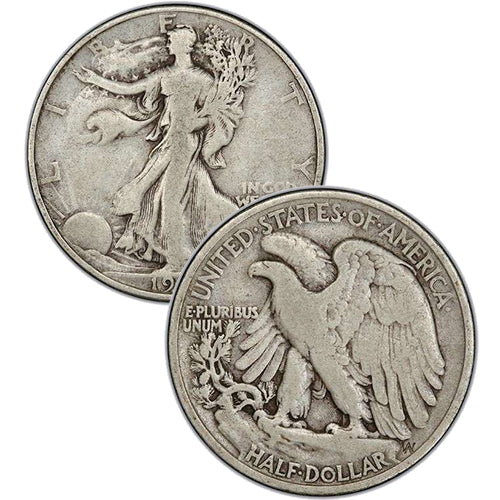
A gem-quality example sold for $48,875 at Bowers & Merena — yet most circulated coins trade under $300. The difference? Strike quality. The 1923-S is the only Walking Liberty half struck in 1923, and sharply struck Mint State survivors are among the rarest in the entire series.
The 1923-S is notorious for weak strikes. A sharply struck coin can be worth 50–100% more than a weakly struck example at the same grade. Use this checker to assess your coin's strike quality before looking up values.
Check all features that match your coin:
Not sure of the grade or variety? Describe what you see on your coin and our keyword-based analyzer will give you a tailored response with actionable next steps.
Once you know your coin's condition and strike quality, the calculator gives you an instant dollar estimate.
Follow the three steps below to get an estimated value range for your 1923-S Walking Liberty Half Dollar.
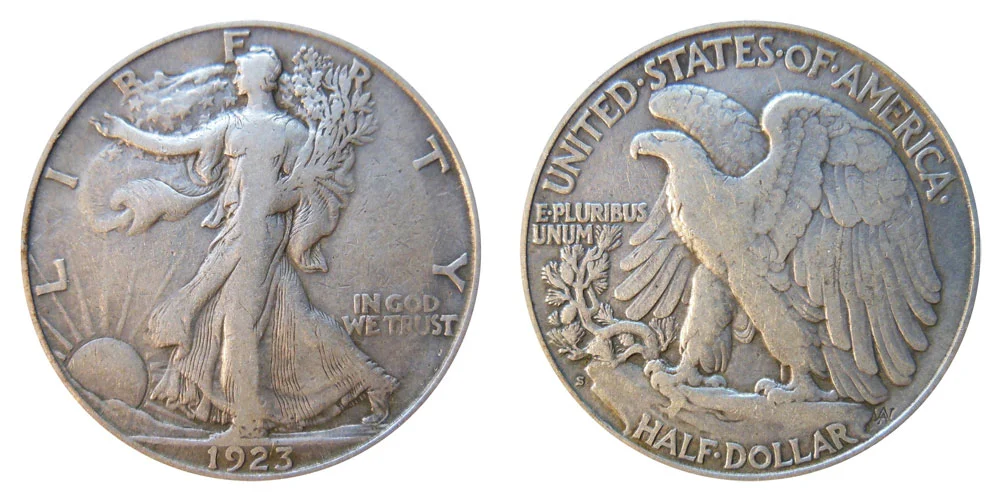
The mint mark is on the reverse, below the eagle's tail feathers.
Base your selection on the highest-wear areas: Liberty's breast, hand, and the eagle's chest.
Check all that apply to your coin.
If you're not yet sure about your coin's grade or errors, a 1923 Half Dollar Coin Value Checker tool lets you upload photos for an AI-powered estimate without needing to assess the details yourself first.
Jump directly to the section you need:
The 1923-S was struck exclusively at San Francisco during a period when that facility had persistent quality-control challenges. The varieties below range from the nearly universal weak-strike issue to rare mechanical errors that can multiply a coin's base value several times over. Each variety has specific diagnostic features you can verify with a 10× loupe.
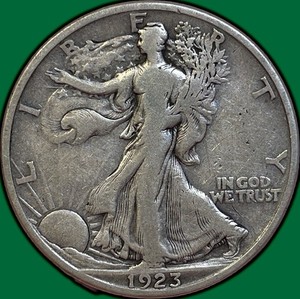
MOST FAMOUS
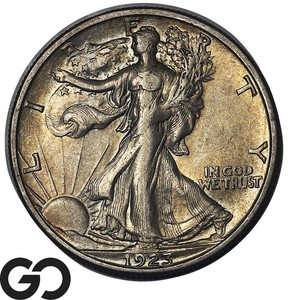
The overwhelming majority of 1923-S Walking Liberty half dollars suffer from inadequate die pressure during the striking process at the San Francisco Mint. This was not a single batch issue — it was a systemic problem affecting most of the 2,178,000-coin production run. Numismatic authorities at PCGS and Stack's Bowers both identify this as the defining characteristic of the date.
The diagnostic signature is flatness at Liberty's left hand and fingers on the obverse and at the eagle's breast and central body feathers on the reverse. Under a 10× loupe, a weakly struck coin shows fingers that merge into a shapeless lump and a branch stem barely raised above the flat field. Sharply struck examples — where fingers are individually defined — are genuinely scarce and constitute perhaps 10–15% of surviving Mint State coins.
Collectors and auction buyers actively seek out sharply struck examples and pay documented premiums. Greysheet and PCGS both note that strongly struck pieces bring premium prices, with some dealers quoting 50–100% over standard values for the same numerical grade. For a collector building a high-quality Walking Liberty set, locating a well-struck 1923-S is one of the series' most celebrated challenges.
MOST VALUABLE ERROR
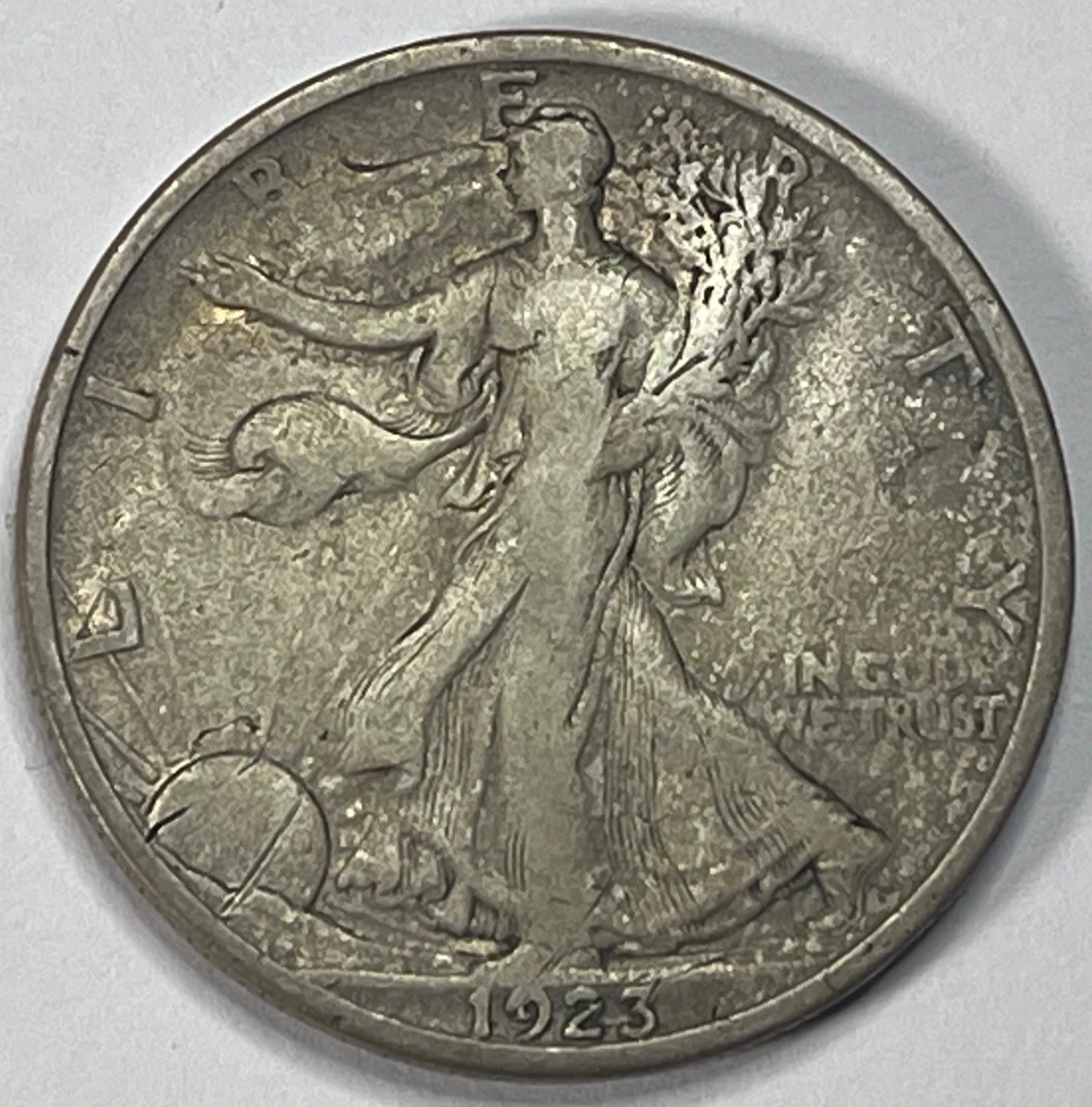
An off-center strike occurs when the planchet is not properly positioned under the dies at the moment of striking, causing the design to be impressed off to one side and leaving a blank crescent of metal on the opposite edge. On a coin with the 1923-S's already substantial base value, any off-center strike commands a significant error premium on top of the silver and numismatic values.
Minor off-center strikes of 5–10% displacement add modest collector premiums of roughly $50–$150 above base value. More dramatic examples — 25% or more off center — are considerably rarer and can reach $500–$1,500 or above, particularly when the full date remains visible. A complete date is essential to establishing year and mint mark, so off-center examples that obliterate the date carry less premium than those preserving it.
The combination of the 1923-S's inherent scarcity with a dramatic mechanical error creates a compelling dual-rarity piece. Full-date off-centers in the 30–50% range and in Mint State or high circulated condition attract serious error collectors at major auction venues. These pieces rarely appear on the market and are best submitted to PCGS or NGC for authentication and attribution before selling.
MOST COLLECTIBLE
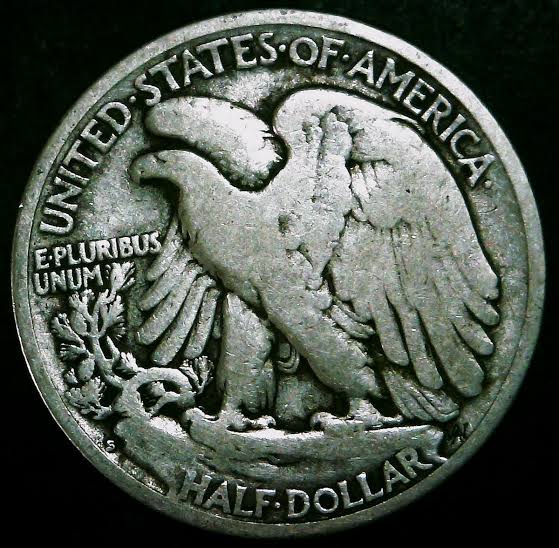
Die cracks form when the hardened steel working dies develop fatigue fractures during extended production runs. On the coin, these fractures appear as raised lines (since the crack in the die becomes a void that fills with metal during striking). The 1923-S production involved relatively heavy die use, and examples with prominent die cracks — particularly those connecting two major design elements — are documented among surviving specimens.
The most collectible die cracks on 1923-S halves are those that run across the eagle's wings on the reverse or connect the rim to a lettering element. A die crack that passes through a Prime Focal Area (the eagle's breast or Liberty's face) commands the greatest collector interest. Minor hairline cracks that do not connect major devices add the smallest premiums — typically 10–15% — while dramatic "retained die break" or "cud" errors (a blob of extra metal at the rim) add 25% or more.
Authentication is straightforward: genuine die cracks are raised above the coin's surface, while post-mint damage (scratches, gouges) is incuse (below the surface). Under a loupe, a crack's edges show the smooth, flowing profile of solidified metal rather than the rough, disrupted edges of a scratch. Because the 1923-S has a higher base value than many Walking Liberty issues, even modest die crack premiums translate to meaningful dollar differences.
BEST KEPT SECRET
A Doubled Die Obverse (DDO) results when a working die receives two slightly misaligned hub impressions during its manufacture, causing design elements to appear with a distinct doubled shadow or step. On Walking Liberty half dollars in general, DDO varieties typically manifest as doubling on the motto IN GOD WE TRUST, the legend LIBERTY, or the date numerals. While no major catalogued DDO variety (with an official FS number from CONECA) is currently listed for the 1923-S, minor hub doubling has been reported on isolated specimens.
To identify potential DDO doubling on a 1923-S, examine the letters of IN GOD WE TRUST under a strong 10× loupe, looking for a step-shelf at the inner edge of each letter or a duplicated serif. The date area — particularly the "1923" numerals — is another prime location. Any doubling seen here is mechanical hub doubling (Class I–IV) rather than machine doubling (which appears as a flat, shelf-like smear and adds no collector value).
The absence of a catalogued major DDO for this date actually increases the potential value of a confirmed attribution. Any specimen with confirmed hub doubling should be submitted to PCGS or NGC for authentication and, if verified, could receive attribution that significantly elevates its desirability among Walking Liberty specialists. Until professionally certified, treat any reported doubling as unconfirmed and price accordingly.
RAREST TO FIND
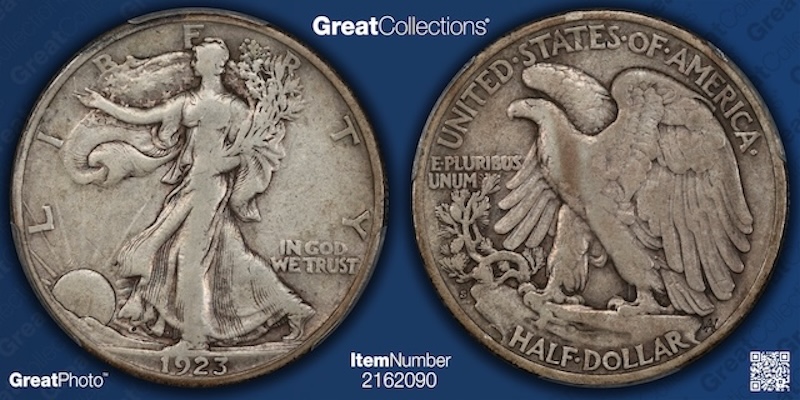
Although technically not a minting error, the sharply struck 1923-S is treated by the market as a distinct premium variety because of how rarely it occurs. PCGS CoinFacts specifically warns that "examples that are relatively sharply struck are hard to find and well worth the premium price they often bring." This is the coin that serious Walking Liberty set builders spend years searching for — a fully struck 1923-S in Mint State grade represents one of the most difficult challenges in the entire series.
The diagnostic test is straightforward and unambiguous: on the obverse, Liberty's left hand must show clearly separated, individually defined fingers, with the olive branch stem appearing as a raised, distinct element. On the reverse, the eagle's central breast feathers must be fully developed and individually delineated — not smeared or flat. Luster on top-quality examples is frosty to semi-prooflike, and attractive natural toning (gray, gold, or rainbow iridescence) adds further appeal to certified coins.
This variety sits at the extreme upper end of the 1923-S value spectrum. In MS-65, examples trade in the $17,000 range; MS-66 coins have sold for over $32,000 at retail and achieved the series' auction record of $48,875 (Bowers & Merena, 2006). The MS-67 — the finest known grade — carries retail estimates of $77,750 to $87,400, reflecting the near impossibility of finding a 1923-S that combines superb strike, original luster, full Gem surfaces, and exceptional eye appeal simultaneously.
Run the calculator to get a specific value estimate based on your coin's mint mark, condition, and the error you spotted.
Values sourced from PCGS, APMEX, USA Coin Book, and CoinValueApp (updated February 2026). Before using this chart, read this detailed 1923 half dollar identification walkthrough and grading guide — matching your coin's grade to the right row is critical for an accurate estimate.
| Variety | Worn (AG–G) | Circulated (VG–VF) | XF–AU | MS-60–64 | Gem MS-65+ |
|---|---|---|---|---|---|
| 1923-S Regular (Weak Strike) | $41 – $59 | $70 – $300 | $1,000 – $3,900 | $4,100 – $8,500 | $17,000+ |
| 1923-S Sharp Strike Premium ⭐ | $55 – $80 | $150 – $600 | $2,000 – $5,500 | $8,000 – $20,000 | $32,000 – $87,400 |
| 1923-S Off-Center Strike | $80 – $150 | $200 – $600 | $700 – $1,500 | $1,500 – $3,500+ | $3,500+ |
| 1923-S Die Crack | $50 – $75 | $80 – $350 | $1,100 – $4,500 | $4,500 – $10,000 | $18,000+ |
| 1923-S DDO (if confirmed) 🔴 | Market varies | Submit for attribution | Submit for attribution | Significant premium | Significant premium |
⭐ = Signature variety (highest collector demand at all grades). 🔴 = Rarest variety (no catalogued FS number yet; submit to PCGS/NGC before valuing). All values are estimates; actual prices vary by market conditions and individual coin quality.
📱 CoinHix gives you a fast on-the-go estimate the moment you photograph your coin, without needing to cross-reference multiple price guides — a coin identifier and value app.
| Mint | Mint Mark Location | Mintage | Est. Survivors | Notes |
|---|---|---|---|---|
| San Francisco (S) | Reverse, below eagle's tail | 2,178,000 | Fewer than 5% in collectible condition | Sole 1923 issue; all carry "S" mint mark |
| Philadelphia | — | None struck | — | Production halted after 1922 recession |
| Denver | — | None struck | — | No Denver half dollars 1921–1928 |
| Total 1923 | — | 2,178,000 | — | Low-mintage date; scarce in all MS grades |
Context within the series: The 1923-S is one of only three Walking Liberty half dollars struck between 1921 and 1929 (alongside the 1927-S and 1928-S). No half dollars were produced in 1922, 1924, 1925, or 1926 at any mint. The 1923-S is considered the rarest of the post-1921 trio in Mint State and Gem condition, according to both PCGS CoinFacts and Greysheet.
Grade determines value more than almost any other factor on this coin. Follow the ANA Sheldon scale guidelines below, paying special attention to the 1923-S's endemic weak-strike problem, which can make a Mint State coin appear worn if you're not careful.
Major design elements are visible but flattened. Date is readable. Rim may merge into field in spots. Liberty and eagle are outlines only — no fine detail. Value: roughly $41–$59 depending on severity of wear and silver price. Often sold as bullion near melt value.
Rims fully separate; all legends readable. Liberty's breast and high points show obvious wear. VF-20 shows only a hint of Liberty's left breast. Eagle's feathers heavily worn on high points. Value ranges from about $70 (VG) to $300 (VF-20). Fine examples are popular entry-level collectibles.
High-points show light to trace wear. AU coins retain 95%+ of original luster. Check Liberty's breast and the eagle's chest under a desk lamp for faint rub. "Sliders" (AU-58) are particularly popular as near-MS value-plays. Value: $1,000 at EF-40 to roughly $3,900 at AU-58.
Zero wear anywhere; full original luster. Grading turns on contact marks and eye appeal. At MS-65 (Gem), only very faint marks visible under magnification. Frosty or satiny luster with original toning adds value. MS-65: ~$17,000. MS-66: ~$32,000–$38,000. MS-67 (finest known): ~$77,750–$87,400.
🔍 CoinHix helps you match your coin's surfaces to graded reference images in seconds, making condition comparisons faster when you're at a coin show or sorting a collection — a coin identifier and value app.
Your selling venue should match the coin's grade and value tier. A $55 circulated example and a $30,000 gem need completely different sales strategies.
Best for AU-50 and higher examples. Walking Liberty specialists actively bid at these venues, and competitive bidding frequently pushes realized prices above dealer retail. Heritage and Stack's Bowers have both handled multiple 1923-S halves in gem grades, with the current auction record of $48,875 realized at Bowers & Merena. Consignment fees typically 5–20%; allow 2–4 months to settlement. Certification by PCGS or NGC is strongly recommended before consigning.
eBay is excellent for circulated and lower-MS examples where the coin's grade is easily verified visually. Before listing, search recently sold prices for 1923-S Walking Liberty halves and completed comps to price your coin accurately against the current market. A PCGS or NGC slab significantly widens your buyer pool and reduces buyer skepticism for coins over $500.
Best for immediate cash on circulated examples worth under $300. Dealers typically pay 60–80% of retail for common-grade 1923-S halves and will offer stronger percentages on key AU or MS coins if they know the market. Get at least two dealer quotes before selling. Many dealers will also help identify strike quality and advise on whether PCGS grading makes financial sense for your specific coin.
Peer-to-peer coin forums attract knowledgeable buyers who understand the 1923-S's scarcity and are often willing to pay near-retail for quality examples. Transactions carry no platform fees (unlike eBay's ~13%), though you must handle payment and shipping yourself. Best for coins in the $100–$1,500 range where the added due diligence of an auction house isn't warranted. Always use tracked, insured shipping for any coin over $50.
All 1923 half dollars were struck only at the San Francisco Mint (1923-S). In Good (G-4) condition they typically trade around $52–$55. By Very Fine (VF-20) prices climb to roughly $275–$300. Uncirculated MS-60 examples fetch approximately $4,000–$5,000, while gem MS-65 coins command $17,000 or more. The auction record is $48,875 for a PCGS MS-66, set at Bowers & Merena in November 2006.
No. In 1923 the U.S. Mint halted half dollar production at Philadelphia and Denver following the economic downturn of 1922. Only the San Francisco Mint struck Walking Liberty half dollars that year, making the 1923-S the sole issue. Every genuine 1923 half dollar carries an 'S' mint mark on the reverse, below and to the left of the eagle's tail feathers.
Three factors drive value: low mintage (only 2,178,000 struck), a large attrition rate because few were saved in high grade, and the endemic weak-strike problem that makes sharply detailed Mint State survivors exceptionally rare. The 1923-S is considered the toughest of the post-1921 trio (1923-S, 1927-S, 1928-S) in MS and Gem condition, commanding strong premiums among Walking Liberty specialists.
The mint mark 'S' appears on the reverse (back) of the coin, at approximately the 7 o'clock position below the eagle's tail feathers, near the bottom of the design. On early Walking Liberty issues the mint mark was sometimes placed on the obverse, but from 1917 onward it was standardized to the reverse position used on the 1923-S.
Examine Liberty's left hand holding the olive branch on the obverse under a 5×–10× loupe. On a weakly struck coin, the fingers are indistinct or merge into a blob, and the branch stem is flat. On a sharply struck coin, the fingers are individually defined and the branch shows crisp relief. Also check the eagle's breast feathers on the reverse — weak strikes show smeared or flat feathers across the central chest area.
The predominant variety is the Weak Strike, affecting the majority of surviving specimens and caused by insufficient die pressure at the San Francisco Mint. Off-center strikes (5–25% displacement) add value, with dramatic examples fetching several hundred dollars above base. Die cracks add modest premiums. Minor Doubled Die Obverse (DDO) hub doubling has been reported on isolated specimens, though no major catalogued DDO is currently listed by PCGS or NGC.
Of the 2,178,000 struck, numismatic researchers estimate fewer than 5% survive in collectible condition. In high Mint State grades (MS-65 and above), the population is extremely thin — PCGS and NGC combined census figures show only dozens of coins at MS-65 or finer. This extreme rarity in gem grades is a primary reason top-grade examples command five-figure prices.
No. Cleaning a coin — even lightly with a cloth or mild chemical — permanently damages the original surface and destroys numismatic value. A cleaned coin may look brighter but will be downgraded to 'Details' status by PCGS or NGC, typically reducing its value by 30–70% compared to an original-surface example in the same grade. Always submit raw coins to a grading service in original, uncleaned condition.
The 1923-S Walking Liberty half dollar contains 90% silver and 10% copper, with a total weight of 12.5 grams. This gives it approximately 0.3618 troy ounces of pure silver. At current silver prices around $30–$33 per troy ounce, the melt value is roughly $10.85–$12.00 per coin. However, numismatic value far exceeds melt value for most collectible examples.
For circulated examples worth under $500, eBay or a local coin dealer provide quick liquidity. For AU or better examples worth over $1,000, submitting to PCGS or NGC for certification first is strongly recommended — it dramatically broadens the buyer pool and often increases realized prices. Gem MS-65 and finer coins should be consigned to major auction houses such as Heritage Auctions or Stack's Bowers, where Walking Liberty specialists compete actively.